
Sediment-rIch Glacial Meltwater plumes affecting benthic-pelagic habitats at recently deglaciated coasts at the Beagle Channel (Isla 25 de Mayo), Antarctica (SIGMA-II expedition leg 1, 2024)
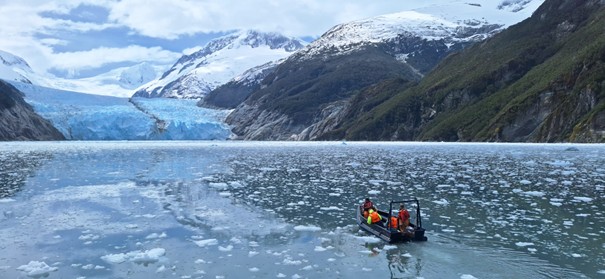
The Southern Patagonian fjord region is a remarkable coastal area of a rich marine ecosystem and dynamic landscape evolution driven by glacier retreat. In an interdisciplinary, international team, we investigate the supply of nutrients and sediments through glacial meltwater runoff and its effects on the fjord's ecosystem.
Our research, conducted aboard on the L/M Huracan, took us to the fjords of the Beagle Channel. These fjords are influenced either by marine-determined glaciers that promote upwelling of nutrient-rich waters or by land-terminated glaciers that maintain a stratified water column. Our fieldwork employed a range of methods to examine biological, physical, and chemical processes along environmental gradients from the glacier front to the deep-water zones at the fjord mouth. Sampling of stream water in glacier forefields provide insight into weathering and erosion processes on land.
We monitored meltwater plumes in the fjords by UAV-based multi-spectral mapping, water sampling and in situ measurements to assess turbidity and organic carbon content in suspended sediments, which are closely linked to biological activity. Sediment cores were collected to examine accumulation and diagenetic processes. Scuba divers mapped the community structure of the benthic fauna in kelp forests with photoquadrats and video transects, providing key insights into distinct ecosystems.
Additionally, we investigated the composition and abundance of zooplankton communities in deep fjord water. Through image and spatial analyses, along with geochemical data, our research aims to provide a comprehensive understanding of the dynamics of the glacial forcing on marine ecosystems within Patagonian fjords. This work holds promise for offering valuable insights into the future of Antarctic fjords.
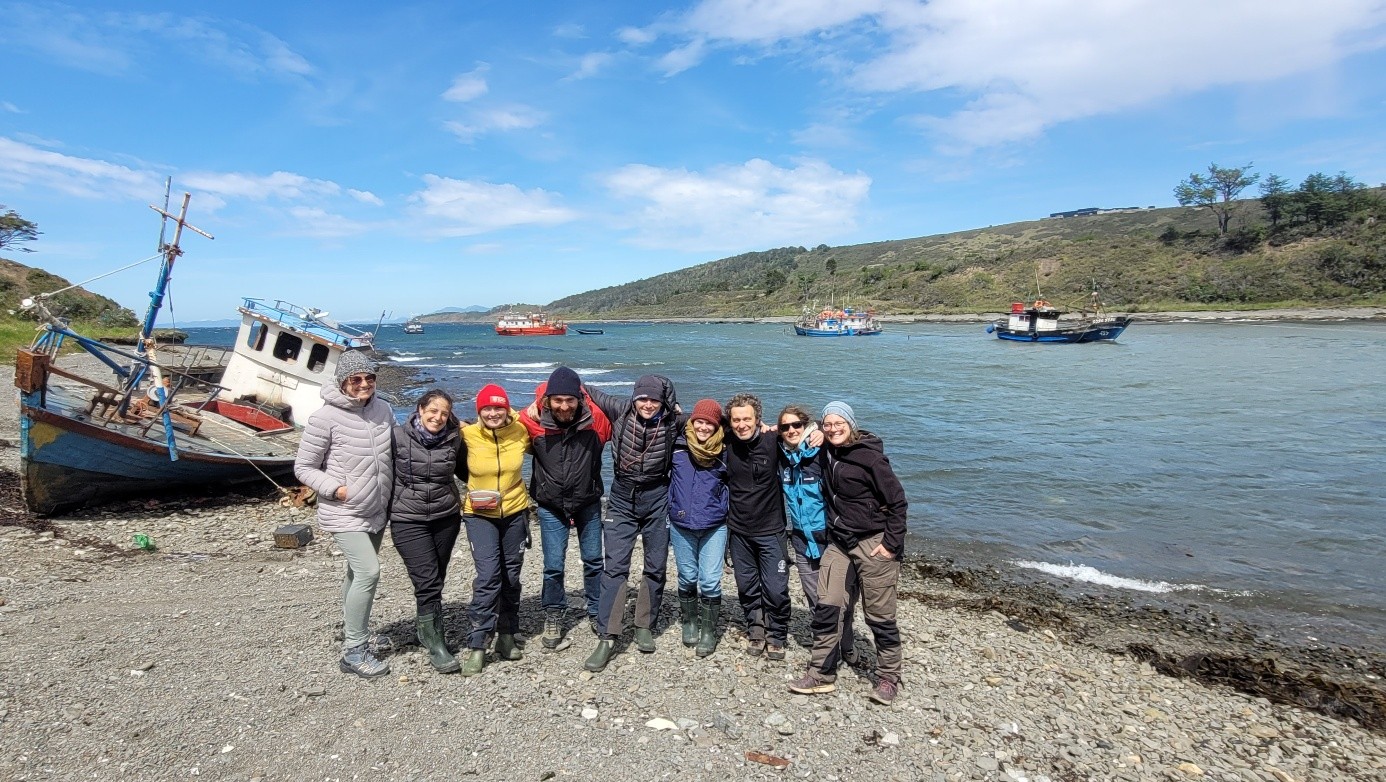
Photo : CoastCarb Beagle Channel explorers ’24: Katarzyna Błachowiak-Samołyk (IO PAN, Poland), Kerstin Jerosch (AWI, Germany), Maria Włodarska-Kowalczuk (IO PAN, Poland), Rafał Boehnke (IOPAN, Poland), Piotr Bałazy (IOPAN, Poland), Clarissa Vock (AWI, Germany), Mariano Rodríguez (ICPA-UNTDF, Argentina), María Bagur (CADIC-CONICET, Argentina), Grit Steinhoefel (AWI, Germany).