
by Gesche Krause, Ramón Filgueira, Nesar Ahmed, Karen A. Alexander, Furqan Asif, Lucia Fanning, Sebastian C. A. Ferse, Nike Fuchs, Jon Grant, Jordi Guillen, Christina Hörterer, Teresa R. Johnson, Matthias Kaiser, Hauke L. Kite-Powell, Cornelia M. Kreiss, Doug Lipton, Sandra L. Marin, Eirik Mikkelsen, Laura Nahuelhual, Selina M. Stead, Sander W. K. van den Burg, Sebastián Villasante
The Local Turn in a Global Sea: Identifying Sustainability Trade- Offs in Regionalized Marine Aquaculture Systems
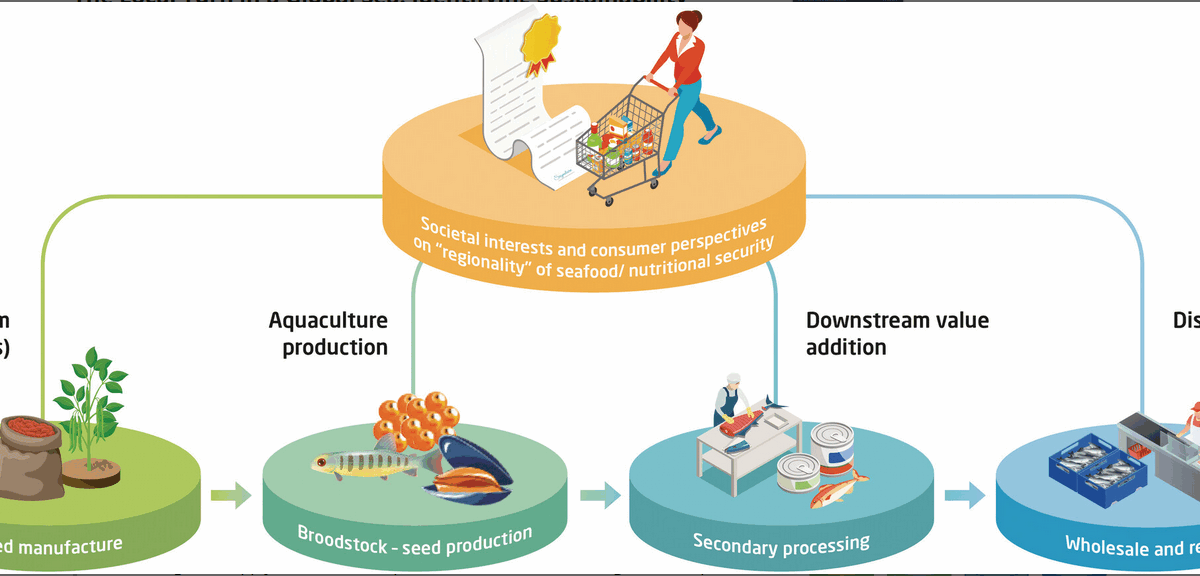
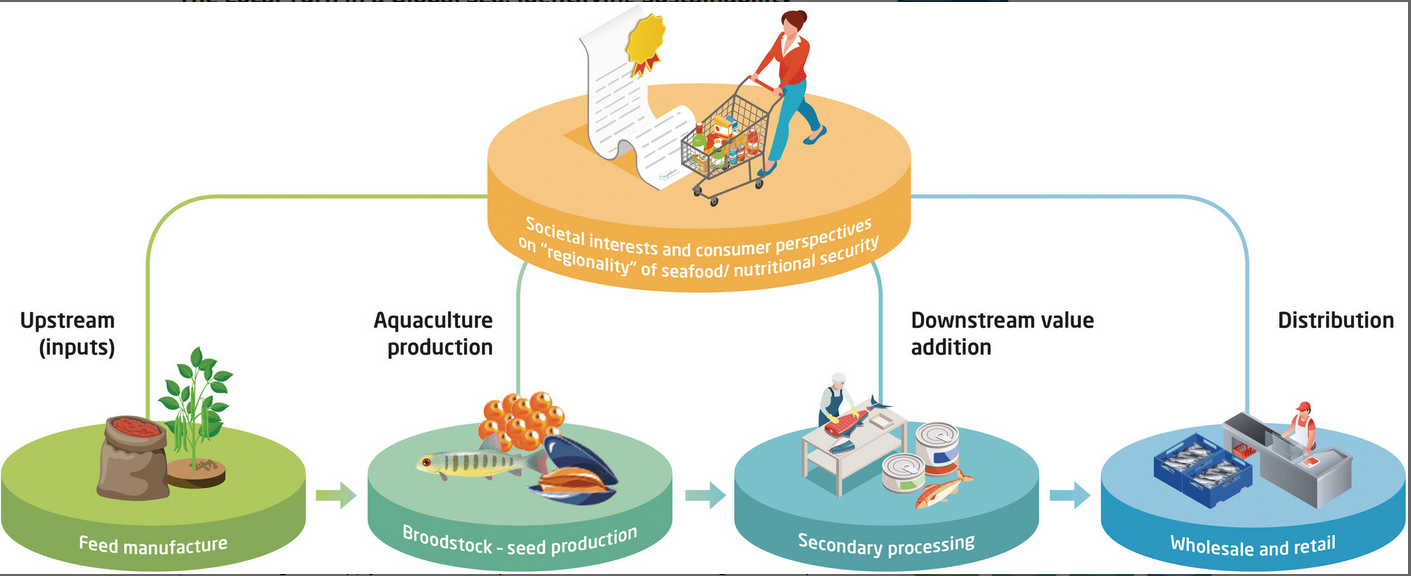
Marine aquaculture, like the broader seafood industry, relies heavily on international trade and global supply chains for both production and sales. Recent global disruptions, including the COVID-19 pandemic, the Russian invasion of Ukraine, the conflicts in the Middle East, and trade tensions, have exposed the social and economic vulnerabilities inherent in a globalized production system. In response, these events have sparked growing interest in transitioning to localized and regional supply chain models. Calls to “buy national” and support domestic economies highlight this trend toward regionalization. This study explores the sustainability implications of regionalizing marine aquaculture by examining the four key segments of the supply chain. These are (1) upstream inputs and resources (2) aquaculture production (3) downstream added value-processing and (4) distribution–transportation. Potential benefits of regional production models include increased resilience to disruptions, lower transportation-related carbon emissions, and support for local economies. However, such models may also introduce trade-offs, including reduced production efficiency, supply and sales limitations, and implications for social, cultural, and governance structures. Our analysis reveals that the sustainability outcomes of regionalization are complex and context-dependent. It is influenced by the specific characteristics of existing supply chains and the regional contexts in which they operate. While regionalization may offer advantages in certain contexts, it does not guarantee improved sustainability. Thus, it is crucial to critically assess the assumption that regionalization inherently leads to improved sustainability outcomes. Proactive evaluation of these dynamics is essential to develop strategies that maximize benefits while addressing potential trade-offs.
by Gesche Krause, Ramón Filgueira, Nesar Ahmed, Karen A. Alexander, Furqan Asif, Lucia Fanning, Sebastian C. A. Ferse, Nike Fuchs, Jon Grant, Jordi Guillen, Christina Hörterer, Teresa R. Johnson, Matthias Kaiser, Hauke L. Kite-Powell, Cornelia M. Kreiss, Doug Lipton, Sandra L. Marin, Eirik Mikkelsen, Laura Nahuelhual, Selina M. Stead, Sander W. K. van den Burg, Sebastián Villasante